
- News
- City News
- chennai News
- When law is the balance between rituals and rights
Trending
This story is from May 24, 2022
When law is the balance between rituals and rights
The recent dramatic ban by the Tamil Nadu government of the Dharmapuram Adheenam pattina pravesam and its subsequent volte face has raised numerous questions in the minds of people.
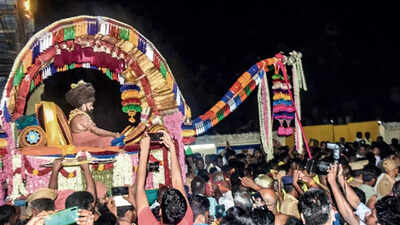
The ban that was ordered by the RDO of Mayiladuthurai last month referred to Article 23(1) of the Constitution that prohibits traffic in human beings and other similar forms of forced labour
One of them being whether ritualistic practices need any insulation from the long arm of the law even if they are anachronistic and/or challenge human rights and dignity? Pattina pravesam observed by the Dharmapuram Adheenam requires the seer to be carried on a palanquin on the shoulders of devotees.

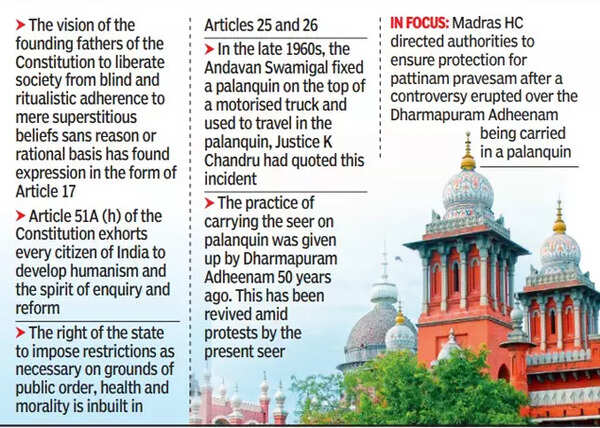
The ban that was ordered by the revenue divisional officer (RDO) of Mayiladuthurai last month referred to Article 23(1) of the Constitution that prohibits traffic in human beings and other similar forms of forced labour. The order categorically stated that the seer was only banned from being carried physically by people in a palanquin and there was no objection to the seer touring places in the name of pattina pravesam.
The said ban which was revoked on May 8 was seen as a reformist agenda by a section of society and viewed with suspicion by others who saw it as an intrusion into their religious beliefs and practices apart from being an attack on their religious freedom.
The Supreme Court has consistently evolved ‘Doctrine of Essential Religious Practice’ as a standard test for adjudicating constitutionally permissible religious practices stretching from the famous Shirur Mutt case (1954) to the Ajmer Dargah case (1961), then the Ananda Margis case (2004) and more recently the Sabarimala case (2018).
What comes to mind is a statement by B R Ambedkar in the Constituent Assembly during one of the debates on codification of Hindu law. He said: “The religious conceptions in this country are so vast that they cover every aspect of life from birth to death; there is nothing extra, there is nothing extraordinary in saying that we ought to strive hereafter to limit the definition of religion in such a manner that we shall not extend it beyond beliefs and such rituals as may be connected with ceremonials which are essentially religious.”
Articles 25 and 26 of the Constitution protect rituals and observances, ceremonies and modes of worship that are integral parts of religion. But what exactly constitutes an essential part of religion and its practices has to be decided by courts only with reference to that particular religion and its practices. In this context, pattina pravesam on a palanquin has today become redundant because of the use of motor transport which was not in vogue then.
A 2017 report by the Pew Research Centre in the US says government restrictions on religion by way of laws, policies and state actions restricting religious beliefs and practices have increased markedly around the world in the past decade. Human rights can never be disconnected from religion. Human rights and faith have to co-exist and religious philosophies and practices cannot ever undermine human dignity, human equality and justice.
The Rabat Plan of Action (2012) promoted by the Office of the High Commissioner for Human Rights (OCHR) through UN-approved ‘Faith for Rights’ and the subsequent Beirut Declaration in 2017 requires nations to ensure that interpretation of religion or belief should add to the level of protection of human dignity that human-made laws provide for. It asserts that religions flourish only in environments where human rights, based on the equal worth of individuals are protected. The 18 commitments under it talk largely about human rights that need to be entwined with deep-rooted ethical and spiritual foundation provided by religions and beliefs.
Any ritualistic practice that is merely for symbolism and is additionally in conflict with human rights and dignity needs to be given up. Even assuming for a moment that the seer shall be carried on the palanquin only by willing devotees; practically speaking, the responsibility most often falls on the employees (sippanthis). This is obvious from giving ‘pallakku manyam’ or a grant to lift the palanquin to the bearers.
When a dispute arose at the Ranganathar Temple, Srirangam, among the descendant-beneficiaries of Sree Veda Vyasa Battar Swamigal family about who is entitled to be carried on the palanquin (Brahmaratham) on the temple premises, the trustees had passed resolution in 2010 giving up the practice of carrying person(s) in palanquin. The Tamil Nadu Association of Temple Employees also passed a resolution then stating it would not take part in any practice of carrying person(s) in a palanquin on temple premises.
Though certain practices are followed for many years such that they form part of religious rights recognised under Articles 25 and 26 of the Constitution, a reasonable restriction can be imposed by the state if warranted.
Many religious institutions have in their own way adapted their routines to the times. They must come forth willingly to display similar spirit and determination to embrace a new approach by modifying age-old practices that have lost relevance and sense of purpose. By doing so, the seers would be practising the highest form of spiritualism by treating fellow human beings as equals. A modern democratic welfare state has all the right to prohibit regressive practices and to regulate any non-essential religious activities.
(The writer is an advocate in Madras high court)
End of Article
FOLLOW US ON SOCIAL MEDIA





Hot Picks
TOP TRENDING
Trending Stories
In City
Entire Website
- 'We were treated like slaves, made to work for 15 hours a day': Tricked into Ukraine war, 3 from Karnataka return home
- 'My father was on the flight': Jaishankar opens up about 1984 Air India hijack
- Airtel CEO Gopal Vittal sends letter to Reliance Jio, Vodafone-Idea, Tata Tele and BSNL CEOs; here's what he said
- Prince Harry to celebrate 40th birthday away from Meghan Markle
- Haitian immigrant pet-eating row: Ohio woman accused of eating cat is US citizen, video is not from Springfield
- Kejriwal out of jail; 'CBI arrest only to frustrate ED case bail': SC judge
- Donald Trump reveals what Laura Loomer is to his campaign: 'I don't control her'
- Hamster Kombat Daily Cipher Codes and Combo Cards for September 14, 2024: Unlock up to 1 million coins
- Laura Loomer's photo with Donald Trump viral. People ask where's Melania, where's wedding ring
- Garena Free Fire MAX redeem codes for September 13: Win in-game goodies and rewards
- 'Water reached tomb of Shahjahan': After heavy rain, leaking from Taj Mahal's dome
- ACT Hockey: India hold nerves to beat Pakistan 2-1 in a thriller
- How Yechury went from Indira’s tormentor to Rahul’s mentor
- FIR filed over fireworks outside Arvind Kejriwal's residence
- Congress demands action against Noida DM over 'Pappu' post on Rahul Gandhi
- Case registered against SP MLA for 'torturing, assaulting' minor maid
- Five things to keep in mind before betting on Bajaj Housing Finance
- Noida woman loses Rs 27 lakh in SIM card 'hacking': Big mistake she made
- Life is not 'khata-khat': Jaishankar's jibe at Rahul Gandhi in Geneva
- Dalit boy stripped naked, forced to dance for stealing wire in Kota

Popular Categories
Hot on the Web
Top Trends
Trending Topics
Korean TeaSector 36 ReviewGreen Apple BenefitsPriyanka Chopra TattooKottukkaali OTT ReleaseNational Parks In IndiaGhaziabad Juice SellerGOAT CollectionVikas Sethi DeathMalayalam ProducersIndia's Best Dancer 4Simi GarewalDilli BabuIndian National ParksLaung BenefitsVikas SethiApple iPhone 16Donald TrumpAadhar Card Update By Sept 14Wordle Answer
Living and entertainment
Latest News
Kaun Banega Crorepati 16: Can you guess the answer for this Rs 3,20,000 question on Navy, which contestant Naman Jain incorrectly answered?Hindus take to Bangladesh streets to stop attacks and demand justiceEdible oil import duty hiked by 20%'Calling all Swifties for Trump': Donald's new campaign merch imitates Eras Tour shirtsWWE Hall of Famer Watches 15 Hours Of Wrestling Each WeekDallas Cowboys Set to Defend AT&T Stadium in Week 2 Clash with New Orleans SaintsTovino on training for Kalaripayattu in ‘ARM’: I practiced every single day, even if I had a hectic day on set8 animals that reproduce without matingThrowback: When Alia Bhatt responded to insecurity questions about Ranbir Kapoor, shut down gossipIndia's T20I captain Suryakumar Yadav turns 34: A glimpse into his stellar T20 career'Forgive me, I don't belong ...' : Tamil Nadu hotelier's apology to FM Nirmala Sitharaman over GST remark triggers political rowRakul Preet Singh reveals Bollywood stylists charge from Rs 15000 to Rs 1 lakh for one event, one outfit: 'Living in Mumbai requires a lot of PR'September 14, 2024: Flying creatures and how their wings workThrashed for 'molesting' kid on train, rail staffer diesKejriwal walks out of jail, says morale is up by 100 timesDhruv Kapila's health setback shatters Indian pair's Vietnam Open semifinal hopesFormer Titans Cheerleader Danielle Sekelsky Begins WWE NXT Training"Birthday aapka hug aur paari I am getting...": Tahira Kashyap pens adorable b'day wish for hubby Ayushmann Khurrana
Copyright © 2024 Bennett, Coleman & Co. Ltd. All rights reserved. For reprint rights: Times Syndication Service